
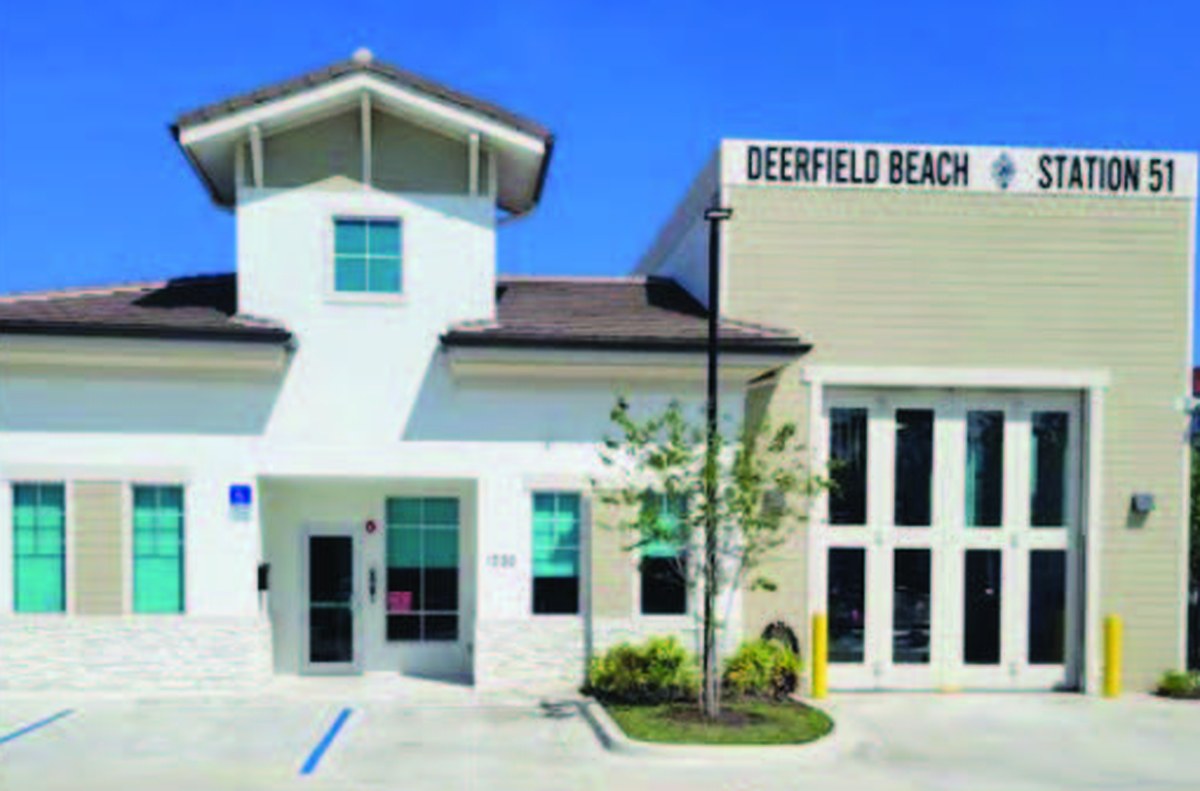
Home › Projects › Deerfield Beach, Florida
Police & Fire Rescue · Feasibility & Transition
Deerfield Beach Public Safety Feasibility Study
CPS evaluated whether Deerfield Beach should continue receiving law enforcement and fire rescue services under contract from the county sheriff’s office or establish independent municipal departments, modeling both options on the same basis across a twenty-year horizon.
The engagement
What We Did
The City of Deerfield Beach receives law enforcement and fire rescue services under separate contracts with the Broward Sheriff’s Office, and retained The Center for Public Safety to examine what establishing independent municipal departments would involve. The city presents an unusual service profile. A resident population of 87,650 supports a peak service population between 150,000 and 200,000, driven by more than four million annual visitors to the beachfront district, and law enforcement workload alone, emergency and non-emergency together, reaches 67,842 calls for service each year in the sheriff’s office dispatch records. Our charge was to describe both service models on the same basis, so that the Commission could weigh them against one another rather than against expectation.
The work was organized around four analytical components. Financial modeling projected both models across a twenty-year horizon, long enough to capture full capital lifecycles and the compounding effect of differing escalation assumptions, with sensitivity testing applied to each driving variable. The staffing analysis applied the ICMA Rule of 60 to patrol allocation, workload-driven deployment modeling to Deerfield Beach call-for-service data, and compensation benchmarking against twelve comparable Florida municipalities selected for coastal character, tourism activity, and population range. The capital assessment priced vehicles, technology, radio communications, equipment, and facility work from 335 verified vendor quotations gathered from 33 suppliers across nine categories rather than from rules of thumb. Implementation planning then established the sequence, dependencies, and duration a conversion would require.
The finished study runs to four volumes and sixteen analytical sections, arranged for review by different audiences. It sets out a complete organizational design for a proposed police department of 158 authorized positions across seven divisions and a municipal fire rescue department of 145 positions maintaining the same six-station coverage with Advanced Life Support transport, alongside facility space programming, a governance framework, and continued reliance on the county’s regional Next Generation 911 dispatch. The final volume carries a four-phase implementation roadmap spanning sixteen to twenty-four months, a critical path with durations and float, procurement and human resources strategy, and a risk register scoring financial, operational, personnel, and external risks with mitigation assigned to each. Every assumption and source is documented so that the City can test the analysis independently.
Related work
Other Engagements
Lady Lake, Florida
Lady Lake Police Headquarters Planning Study
CPS completed an integrated planning study for the Lady Lake Police Department, combining a twenty-year staffing projection with room-by-room space needs assessments at the two building sizes the Town asked to see, 45,994 and 62,354 gross square feet, each priced to a probable project cost on the same 5.5-acre site.
View project
St. Cloud, Florida
St. Cloud Police Staffing Study
CPS prepared a workload-based staffing analysis for the St. Cloud Police Department covering five divisions, projecting personnel needs from 2024 through 2050 against population forecasts that carry 69,211 residents in 2024 to between 142,791 and 216,350 by 2050.
View project
Palm Bay, Florida
Palm Bay Police Staffing Study
CPS examined patrol, investigative, and communications center workload for the Palm Bay Police Department, building a phased ten-year staffing and civilianization plan from four fiscal years of dispatch data and a planning zone growth projection, then testing the result against a multi-construct peer benchmark.
View projectStart the conversation
Tell Us What Your Agency Is Facing.
Most agencies call us about a budget request, a growth pressure, or the start of a facility project. A short conversation is usually enough to tell you whether a study is the right next step, and what it would involve.