
Home › Projects › Palm Bay, Florida
Police, 911 · Staffing & Deployment
Palm Bay Police Staffing Study
CPS examined patrol, investigative, and communications center workload for the Palm Bay Police Department, building a phased ten-year staffing and civilianization plan from four fiscal years of dispatch data and a planning zone growth projection, then testing the result against a multi-construct peer benchmark.
The engagement
What We Did
The City of Palm Bay is the most populous municipality in Brevard County, home to 158,388 residents across 88 square miles, with an inventory of platted but not yet developed subdivisions that will continue to absorb residential growth over the next decade. The city retained The Center for Public Safety through a competitive procurement to examine staffing across every operational domain of its police department: patrol deployment, response time performance, investigative caseload, communications center workload, civilianization opportunity, overtime trajectory, and a long-range projection carrying the findings forward on a ten-year horizon. Because the scope reached across patrol, investigations, the communications center, and five planning zones, the engagement ran on the full 180-day schedule rather than the shorter cycle a narrower single-agency review follows, with data collection occupying the first sixty days.
The patrol analysis paired the Rule of 60 workload computation with a performance-based adaptive staffing model, both resting on a net availability derivation that works down from the 2,080-hour annual base by explicit deduction of leave, training, court, and administrative time, so that each computation can be read line by line rather than accepted on assumption. Investigative requirements were calculated from a per case type work hours framework that decomposes each unit’s annual caseload by case category and multiplies through published per case hours drawn from subtask-level workflow models. The communications analysis applied APCO Project RETAINS alongside the NENA 90/10 service level framework. Peer benchmarking ran as three separate constructs: a nine-agency Florida peer set, a fourteen-agency dispersion analysis widening the statistical envelope, and a six-agency narrative profile developed during the qualitative phase.
The ten-year projection was built position by position rather than at a uniform citywide rate, classifying every position against a five-category staffing typology and modeling growth across five planning zones with probability-weighted development pipelines. The finished report runs to nine analytical chapters and closes with a consolidated matrix of seven recommendations, each carrying an identifier traceable to the section supporting it, alongside a tiered civilianization plan, beat realignment scenarios, and a response time service standard the city can adopt and report against on a recurring cadence.
Related work
Other Engagements
Pompano Beach, Florida
Pompano Beach Police Department Transition Study
CPS examined what establishing an independent municipal police department in Pompano Beach would require, preparing a facility program, a technology needs assessment, a hiring and retention plan, and planning-level cost estimates for a department of 271 sworn and 90 civilian positions, housed in a facility programmed to a 400-person design capacity.
View project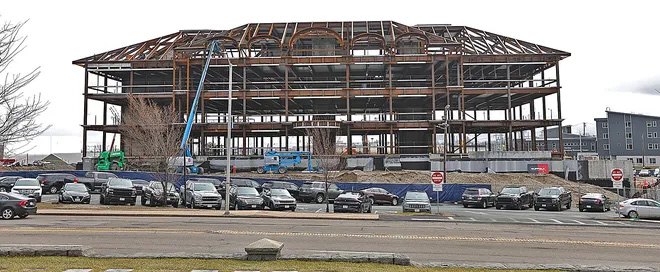
Gwinnett County, Georgia
Gwinnett County Police Headquarters Space Needs Assessment
CPS prepared the final program and spatial needs assessment for a consolidated Gwinnett County Police Department headquarters, sizing every unit against three planning horizons and producing a room-by-room program of about 178,000 gross square feet.
View project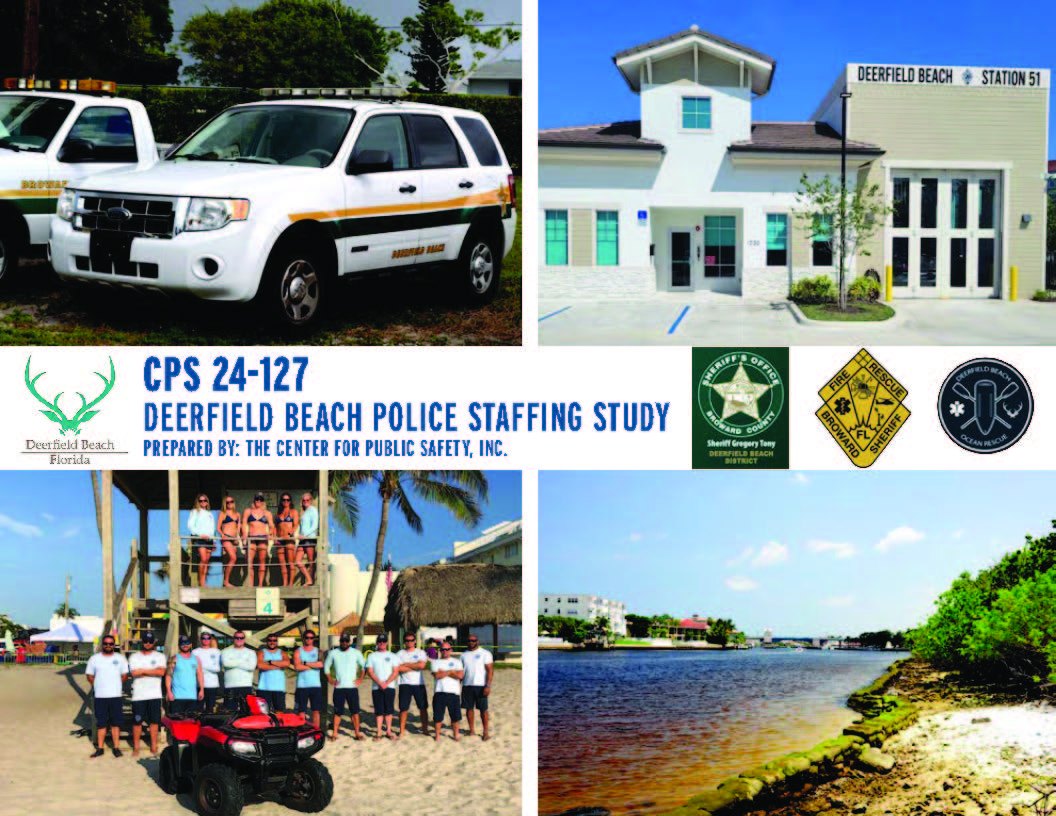
Deerfield Beach, Florida
Deerfield Beach Public Safety Assessment
CPS delivered an integrated staffing study, facilities assessment, and pre-design report covering law enforcement, fire rescue, ocean rescue, park rangers, and code compliance, with a three-phase implementation roadmap through 2031.
View projectStart the conversation
Tell Us What Your Agency Is Facing.
Most agencies call us about a budget request, a growth pressure, or the start of a facility project. A short conversation is usually enough to tell you whether a study is the right next step, and what it would involve.